
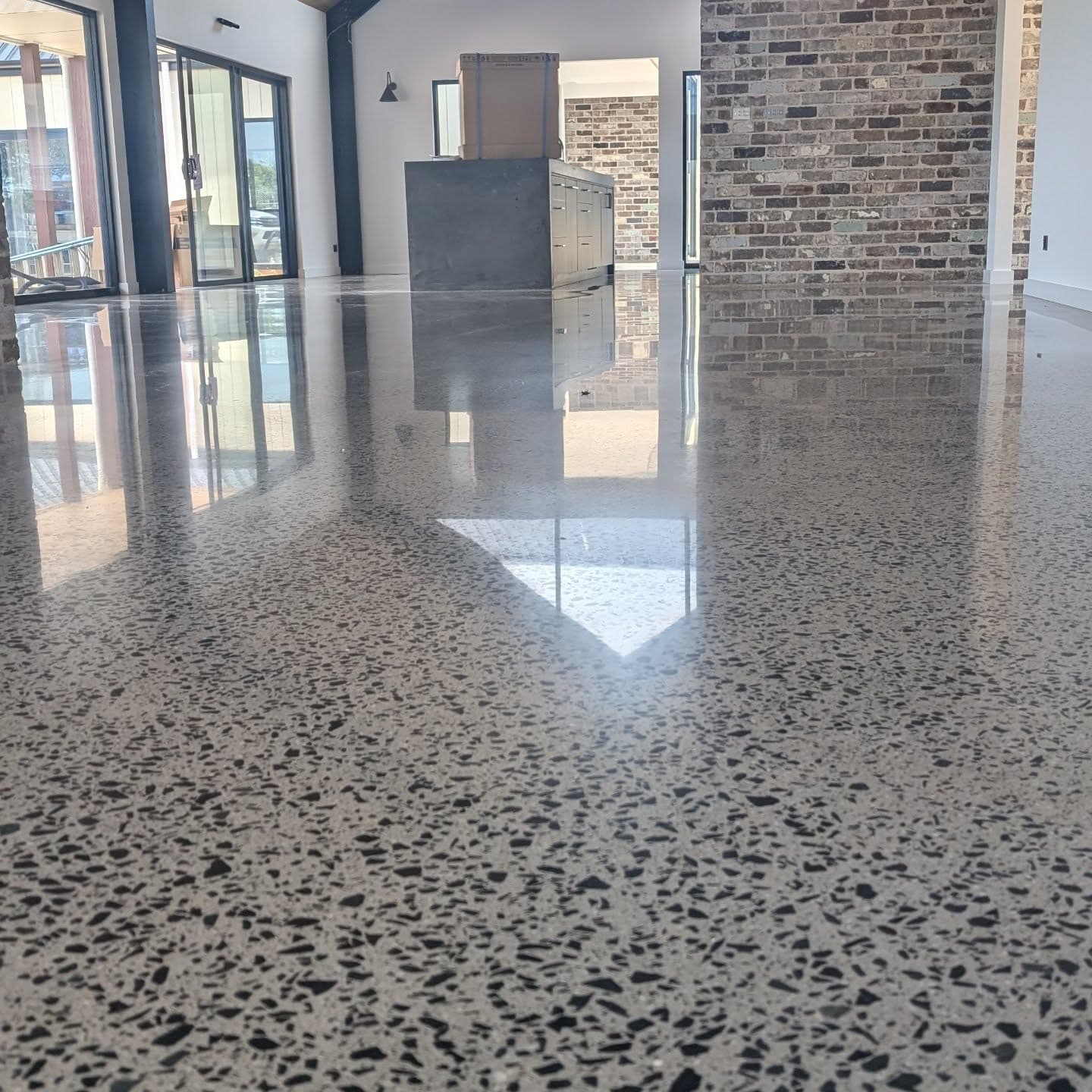
Polished Concrete vs Epoxy Flooring Wollongong — Which Should You Choose?
June 2025 · 7 min read · by Gary, Flash Flooring
Polished concrete and epoxy flooring look similar in photos. They’re both smooth, both low-maintenance, and both a serious upgrade from bare concrete. But they’re fundamentally different products — and choosing the wrong one for your space is an expensive mistake to fix.
Here’s the honest breakdown from a team that installs both, every week, across Wollongong and the Illawarra.
The fundamental difference
Polished concreteis not a coating. It’s the concrete slab itself, mechanically ground and refined through progressively finer diamond tooling until it achieves a sheen. The floor you walk on is the same concrete poured when the slab was laid — just transformed.
Epoxy flooring is a coating applied on top of the slab. Two-part resin and hardener are mixed and applied to a prepared concrete surface. The result is a tough, seamless membrane that bonds to the concrete and creates an entirely new surface layer.
This distinction matters because it affects durability, maintenance, appearance options and the right application for each.
At a glance
| Polished Concrete | Epoxy Flooring | |
|---|---|---|
| Starting cost | From $55/m² | From $45/m² |
| Lifespan | 20–30+ years | 10–20 years |
| Appearance | Matte to mirror-gloss, aggregate exposure | Flake, solid colour, quartz — wide colour range |
| Maintenance | Sweep + damp mop only | Sweep + damp mop, reseal topcoat eventually |
| Best for | Living areas, commercial, restaurants, offices | Garages, workshops, warehouses, heavy-use floors |
| Handles vehicles | Not recommended | Yes — built for it |
| DIY possible | No — requires diamond grinding machines | Partially, but prep is critical |
Cost comparison
Epoxy is generally the more affordable option for garages and smaller areas. A typical single garage (30–40m²) comes in at $1,800–$3,200 for a professionally installed epoxy coating with full diamond grinding prep.
Polished concrete starts from around $55/m² for a matte or satin finish. A semi-gloss is $70–85/m², and a high-gloss mirror finish runs $90–120/m² depending on the slab condition. For a 50m² living area, that puts a satin polish at around $3,500–$4,500.
For large commercial spaces, the costs often converge — both are competitive at scale. We’ll give you a fixed price on-site for either.
Which lasts longer?
Polished concrete wins on raw longevity — because there’s nothing to wear out. The slab is hardened and densified during the polishing process. With a penetrating sealer and basic maintenance, a polished concrete floor easily lasts 20–30 years without any major intervention.
A professionally installed epoxy system — two-part industrial grade, with diamond grinding prep — is realistically 10–20 years. The coating itself doesn’t wear evenly; heavy vehicle traffic areas will show wear sooner than the rest of the floor. A topcoat refresh every 8–12 years is normal on a garage floor that sees daily use.
One important caveat: the prep work defines both lifespans. Epoxy installed without proper diamond grinding will delaminate in 2–5 years regardless of quality. Polished concrete done too quickly through the grit sequence won’t hold a gloss. Done properly, both floors are a long-term investment.
Day-to-day maintenance
Both floors are genuinely low maintenance compared to carpet, timber or tiles.
Polished concrete: sweep, damp mop with a pH-neutral cleaner, done. No waxing, no buffing, no stripping and resealing every few years. The penetrating sealer we apply is inside the concrete, not on the surface — it can’t peel.
Epoxy: same routine for day-to-day cleaning. The difference is the polyurethane topcoat is a surface layer that can develop fine scratches in high-traffic areas over time. This doesn’t compromise the epoxy itself, but can dull the sheen. In residential garages this is rarely noticeable for many years. In commercial workshops with heavy foot and vehicle traffic, a topcoat refresh may be needed at some point.
When to choose polished concrete
- Living areas, open-plan kitchens, hallways — anywhere you want the look of polished stone without tiles
- Restaurants, cafes, retail spaces — hygienic, easy to mop, looks high-end
- Commercial offices and showrooms — durable, professional appearance
- Renovations where the existing slab is in reasonable condition
- Anywhere you want the natural aggregate or terrazzo-style look
When to choose epoxy
- Garages — handles vehicle weight, oil, tyre rubber and chemicals. Polished concrete doesn't.
- Workshops and warehouses — heavy equipment, forklift traffic, constant use
- Industrial and commercial kitchens — seamless, chemical-resistant surface
- Anywhere you want colour options or decorative flake finishes
- When budget is tighter — epoxy is typically more cost-effective per m² for smaller areas
The short answer
If it’s a garage, workshop or any floor with vehicle traffic— choose epoxy. It’s purpose-built for it. If it’s a living area, commercial space, restaurant or office— polished concrete is almost always the better long-term choice. If you’re genuinely unsure, get Gary out for a quote — he’ll look at your slab, your space and your use case and give you a straight recommendation with no upsell.
Common questions
Is polished concrete cheaper than epoxy flooring in Wollongong?
Epoxy starts from around $45–55/m² for residential areas, while polished concrete starts from around $55/m² for a matte finish. However, polished concrete costs more at the higher gloss levels — a mirror-gloss polish can run $90+/m². For most garages, epoxy is more cost-effective. For large residential or commercial spaces, costs are similar.
Which lasts longer — polished concrete or epoxy?
Polished concrete lasts the longer of the two — often 20–30+ years with minimal maintenance, because the floor itself is the concrete slab. A professionally installed epoxy coating with proper diamond grinding prep lasts 10–20 years. Both significantly outlast painted or sealed concrete.
Can you put epoxy over polished concrete?
Technically yes, but it's rarely advisable. Polished concrete has a dense, non-porous surface that's difficult for epoxy to bond to without additional prep work. If you're unsure which to choose, it's better to decide before any work begins — reversing course costs money.
Which is better for a garage — polished concrete or epoxy?
Epoxy, almost always. Garages need resistance to vehicle weight, tyre rubber, oil and chemicals. Epoxy coatings are purpose-built for this. Polished concrete is more suited to living areas, commercial floors and spaces where the aesthetic of polished stone is the priority.
Which is easier to maintain?
Both are low-maintenance. Polished concrete is slightly easier — sweep and damp mop with a pH-neutral cleaner, nothing else required. Epoxy is similar but the polyurethane topcoat can show scratch marks over time in high-traffic areas, whereas polished concrete has no coating to scratch.
Get Started
Not Sure Which Is Right? Ask Gary.
Free on-site assessment — Gary looks at your slab, your space and your budget and gives you a straight answer. Wollongong, Shellharbour, Illawarra and surrounds.